Regaining the Regalia: The Story of Kōzuki Mitsuyoshi and His Daughter Gogo (五々)
Yesterday’s Clarity
“Yesterday’s clarity is today’s stupidity” remarked the Zen monk Ikkyū, well aware of changing expectations of fifteenth-century Japan. Warriors whose forebears had fought to preserve their autonomy could no longer sustain it. Powerful lords, invested with the office of provincial protector (shugo), amassed local authority, yet their power rested on precarious succession to this post. The Ashikaga shoguns uneasily ruled over these shugo, asserting their primacy while their authority over the land was hollowed out. Finally, court nobles—some resentful of Ashikaga hegemony—sought to reignite the civil wars of the fourteenth century by stealing the jewel, one of the three imperial regalia, in order to assert legitimacy and establish a rival imperial court.
The documents translated here attest to folly at every levels. Most catastrophically, Ashikaga Yoshinori (1394-1441, shogun 1429-41) attempted to curb shugo power by fomenting succession disputes to the office of shugo, thereby dividing these families and their followers. Instead, his policy provoked the Akamatsu—among the Ashikaga’s most reliable supporters—to assassinate him. The debacle rebounded on the Akamatsu themselves: Mitsusuke (1381-1441), the lord who orchestrated this assassination, was killed along with most of his relatives and retainers, and their possessions, including their shugo offices for the provinces of Harima, Bizen and Mimasaka, were confiscated. A further failure followed when supporters of two princes seized the jewel in the hope of founding a new court and toppling the Ashikaga. Their hopes were dashed. They were killed and the jewel was ultimately returned to Kyoto.
The only successes came from a band of warriors determined to restore their Akamatsu lords. One of these men, Kōzuki Mitsuyoshi, anticipated little reward for what he believed would be a suicidal mission. He therefore transferred his holdings to his daughter Gogo (五々), leaving her careful instructions on how to survive in the event of his death. Ironically, she predeceased him. Mitsuyoshi, by contrast, lived a long life, surviving not only this episode, but also a decade-long civil war that lasted until 1478. After the conflict ended, he committed his actions to writing so that they would not be forgotten. This incident is mentioned in court chronicles (kiroku 記録), though without the detail of Mitsuyoshi’s account. Despite the many political, social, and intellectual transformations of this period, the impulse to record and remember notable deeds endured.
The Background
Warriors of the fifteenth century faced mounting pressures. Their ability to hold land independently was increasingly constrained as powerful lords, often appointed as provincial “protectors” (shugo) consolidated authority. These lords frequently appropriated as much as half of a province’s revenue, including territory controlled by individual warriors. As a result, many warriors sought the patronage of such magnates, for without their protection, the survival of these families was imperiled. This was certainly the case for the Kōzuki, a branch family of Akamatsu, who abruptly lost their patron in 1441 when their lord, Akamatsu Mitsusuke, was killed and Akamatsu lands were confiscated following the assassination of Ashikaga Yoshinori.
The theft of the regalia posed a serious challenge to the Ashikaga. Their old rivals, supporters of the Southern Court, had long advanced a form of nominalism, insisting that possession of the regalia determined legitimate succession. The Ashikaga, by contrast, had not relied on these objects when enthroning emperors since the 1350s. Yet to defeat their rivals, they now had to prevail on the rivals’ terms by recovering the missing jewel. Ashikaga Yoshimasa (1436-1490), the shogun at the time of the theft, reluctantly accepted a proposal advanced by his shogunal chancellor, Hosokawa Katsumoto (1430-1473), and the court noble Sanjō Sanekazu (1415-84). Sanekazu, an important mediator allied with the Akamatsu, brokered an arrangement whereby the Akamatsu would be reinstated as shugo, though not in their former wealthy province of Harima. Instead, they were granted authority over half of the troubled province of Kaga in north-central Japan.
The undertaking was nearly suicidal. The Princes were entrenched in remote mountains of Yoshino and enjoyed the support of a local populace deeply suspicious of outsiders. Seeking both reward and the rehabilitation of his family’s fortunes, Kōzuki Mitsuyoshi accepted a mission that he believed would almost certainly end in his death.
Kōzuki Mitsuyoshi and His Daughter Gogo (五々)
The Kōzuki were a branch family of the Akamatsu, who rose to prominence in Harima during the thirteenth and early fourteenth centuries. Their fortunate collapsed in 1441, when their lord assassinated the Ashikaga shogun Yoshinori. In the violent purge that followed, most of the Akamatsu and their retainers, including the majority of the Kōzuki, were destroyed. Only a minor branch of the Kōzuki appears to have survived.
The endemic wars were not conducive to longevity, yet Mitsuyoshi proved an exception. Of the thirty men who entered the mountains of Yoshino in 1456, only Mitsuyoshi was still alive in 1478, twenty-two years after the episode. His birth date is unknown, but his survival of the 1441 events suggests that he was relatively young at the time. If, for example, he were born in 1425, he would have been sixteen (by Japanese reckoning) in 1441— young enough to escape the violence, and thirty-one in 1456. Under this reconstruction, he would have been a comparatively young father. If his daughter was born when he was eighteen, she would have been thirteen in 1456; most likely too young for marriage, but old enough to read, respond to, and reflect upon her father’s will. Mitsuyoshi would later fight in the Ōnin war from 1467 to 1477, at roughly forty-two to fifty-two year of age. He appears to have written his chronicle in 1478, when he was approximately fifty-three, and his last verifiable document dates to 1481, when he would have been about fifty-six. These dates are necessarily conjectural, but they offer a plausible framework for understanding his life course. Mitsuyoshi’s robust constitution allowed him to endure a decade of warfare in middle age, and his longevity likely shaped his desire to record the Yoshino episode for posterity, as its sole surviving participant. Notably, however, he showed no comparable impulse to chronicle the decade-long Ōnin War.
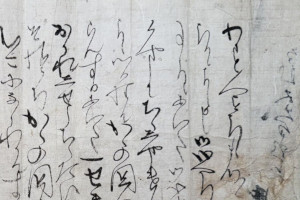
As for Gogo, she was young and unmarried in 1456. No records of her survive beyond her response to Mitsuyoshi’s well, suggesting that her life was short. She was clearly alive in 1456, but the reference to “Praise (namu) Five Element (godai) Offerings (kuryō),” an admittedly obscure phrase, which was later attached to the document, most likely indicates some form of memorialization on her behalf. Gogo, unlike her father, did not live a long life. Nothing is known of Mitsuyoshi’s other offspring. Although the Kōzuki family endured, it is impossible to determine whether Mitsuyoshi left any biological heirs.
The Sources
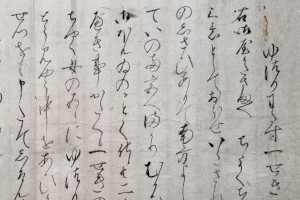
Kōzuki Mitsuyoshi composed a will (Document 1), where he sought to secure the future of his daughter Gogo and her eventual descendants in a world where she herself could not easily possess nor defend his contested landholdings. Gogo’s response, a letter written in her own hand, also survives (Document 2). For reasons that remain unclear, this document has been classified as a will on later notations added to the document, although it is more accurately understood as a reply to her father’s testament in the form of a letter.
Gogo was a capable writer, as demonstrated by Document 2 which is in her own hand. Because paper was expensive, she used almost all of the available space, and there was no need to affix her monogram, as her father would have recognized her handwriting. Mitsuyoshi’s monogram, by contrast, appears both on his 1456 will and his 1478 account. While it remains largely consistent over time, his brush strokes became more fluid with practice.
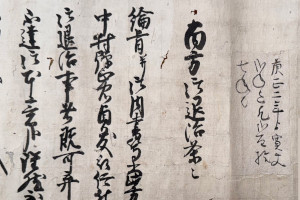
In 1478, Mitsuyoshi composed a narrative on seven sheets of paper describing how a band of warriors killed two princes and captured what he called the Divine Jewel (shinkingyoku 神金玉), one of Japan’s imperial regalia, in an elaborate campaign (Document 3). The success of this mission secured the restoration of their Akamatsu lords. Concerned that his account might later be altered, Mitsuyoshi bound the sheets together, writing his name in monograph format on the edges of both, which prevented the insertion of additional pages or alternative narratives.
As the last surviving participant in the events he described, he recorded them in order to ensure their preservation. Tellingly, he deliberately ignored the long and arduous decade of warfare he endured as a veteran of the Ōnin War. This record, sometimes known as the Kōzuki Chronicle (Kōzukiki 上月記), is a compelling document. It later achieved widespread circulation through its inclusion in the Gunsho ruijū (群書類従), an encyclopedic compendium of sources. As a result, Mitsuyoshi attained a modest degree of posthumous recognition for a warrior of his time and status, even appearing briefly as a character in the 1994 NHK Television Drama Hana no ran (花の乱).
The Incident
For a band of thirty men, the operation required careful and elaborate planning. Kōzuki Mitsuyoshi and his cohorts had to present themselves as disgruntled Akamatsu retainers. The princes, understandably suspicious, permitted only a handful of Akamatsu men to enter mountains and have direct contact with them. To overcome these challenges, the plotters deliberately manipulated prevailing social norms. One Akamatsu retainer, Kodera Yoji, for example posed as a monk named Chū-ami. In this guise, he gained the Princes’ confidence and served as a trusted intermediary, persuading them to rely on men who would ultimately betray them.
In his narrative (Document 3) Kōzuki Mitsuyoshi made a concerted effort to record the names of all participants and the dates of their actions with precision. He does not foreground his exploits; instead he laconically notes that he decapitated the Second Prince and that Nakamura Sadatomo subsequently carried the severed head. Mitsuyoshi also recounts how the Nyūnoya brothers killed the First Prince and briefly secured the Divine Jewel, only to be killed themselves in the snowy mountains of Yoshino, where the jewel was recovered by local inhabitants. The brothers’ sacrifice is corroborated by a document in the Anyōji collection, where a record of lands being commended for the salvation of the first Prince—whom the brothers had killed—and for the brothers themselves in the second month of 1469, twelve years after their deaths.
Mitsuyoshi recounts how “through marvelous planning” the Kodera lay priest (nyūdō) Seisetsu managed to secure the trust of the remaining supporters of the princes and to seize the Divine Jewel once more. The jewel was then returned to the capital, enabling the reinstatement of the Akamatsu. Another figure who figures prominently in the narrative is the Akamatsu retainer Nakamura Danjō no jō (弾正忠) Sadatomo, who played a central role in planning and leading the campaign. He was accompanied by at least four members of his family—Jirō, Gorō, Shinzenbō, and Munemichi— and his retainer Kotani Yoji also appears repeatedly in the account. Sadatomo was ultimately killed on the roadside while carrying the head of the Second Prince. The impulse to commemorate these men, and at times, to pray for their salvation lingered, persisted long after the events themselves, even as the surviving participants became enmeshed in another, very different, and savage war.
Epilogue
The success of Mitsuyoshi and his cohorts in 1457 enabled the Akamatsu to reestablish themselves as partial shugo of Kaga. In the aftermath of the Ōnin war, the Akamatsu once again became lords of Harima, albeit in a considerably weakened position. The Kōzuki remained steadfast in their supported of the Akamatsu and emerged as one of their most trusted retainer families, continuing to fight on their behalf into the 1570s. In 1577, Hashiba (later Toyotomi) Hideyoshi (1537?-1598) invaded Harima at the behest of his lord, Oda Nobunaga (1534-1592). Akamatsu Norifusa was subsequently granted a modest amount of revenue lands in Awa province on Shikoku in 1585. The Kōzuki relocated with the Akamatsu to Awa, and it is there, in what is now known as Tokushima, that their documents have been preserved.
Credits
We gratefully acknowledge Yamada Masayuki, Arashi Daijirō, and the staff at the Tokushima kenritsu monjokan for permitting Thomas Conlan to view and photograph these documents, and to share the images online. Also many thanks to Ben Johnston for his help in creating this website and for seamlessly stitching together the images of Document 3. Our thanks extend to Noda Taizō of Kyoto Tachibana University for his insights and for proofreading the transcriptions, and to Yano Daisuke of the Tokushima kenritsu hakubutsukan for his assistance in facilitating this project. Overview, translations, and transcriptions by Thomas Conlan. Photos by Thomas Conlan.
Footnotes
1. Hyōgo kenshi shiryōhen chūsei 9 kodai hoi (Kobe, 1997), Kōzuki monjo doc. 8, 11.3.1456 (Kōshō 2) Kōzuki Mitsuyoshi iseki yuzurijō, pp. 255-256.
2. Hyōgo kenshi shiryōhen chūsei 9 kodai hoi, Kōzuki monjo doc. 9, Kōzuki Mitsuyoshi me Gogo iseki yuzurijō, pp. 256.
3. Hyōgo kenshi shiryōhen chūsei 9 kodai hoi, Kōzuki monjo doc. 46, 8. 1478 Kōzuki Mitsuyoshi Hori Hideyo rensho Minamikata ontaiji no jōjō, pp. 268-270. See also Mori Shigeaki, Yami no rekishi Gonanchō (Kadokawa sensho, 1997), pp. 210-219.